

Rising Energy Prices: Solid Fuel Use and Heating Affordability in the UK
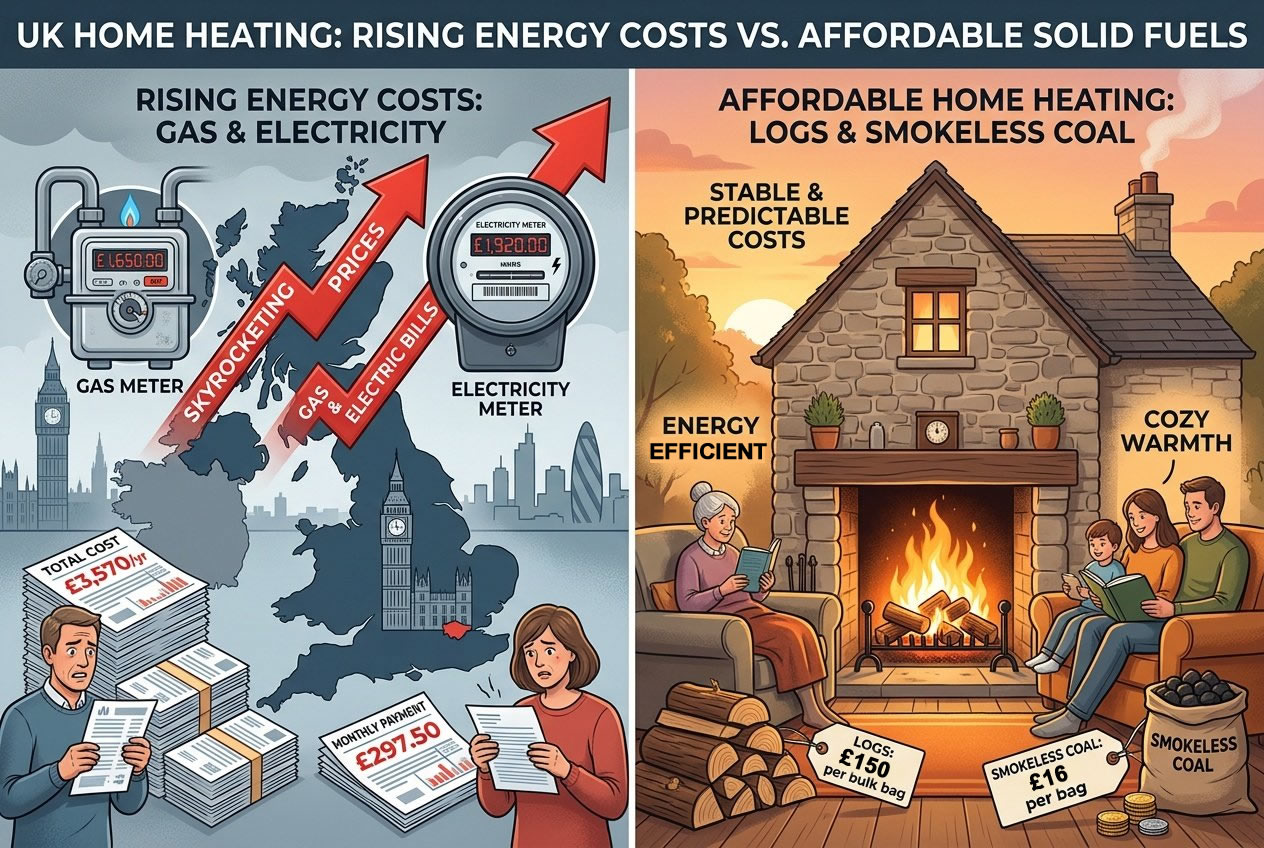
Energy bills in the UK have remained £600 above their pre-crisis average, leaving millions of households struggling to heat their homes affordably.
With around 4 in 10 adults finding it difficult to afford their energy bills as of early 2024, many are reconsidering their heating options.
As traditional gas and electricity costs continue to strain household budgets, an increasing number of people are turning to solid fuels like logs and smokeless coal as more economical alternatives.
The shift towards solid fuel heating reflects a practical response to financial pressure.
Domestic energy costs represent 6% of total household spending on average, but this rises to 10% for the lowest income households.
When families face choices between heating and other essentials, the cost per unit of heat becomes a critical factor in decision-making.
Understanding the true costs and efficiency of different heating methods helps households make informed choices.
Logs, smokeless coal, gas, electricity, and oil each offer different price points and heat outputs.
The economics of heating extend beyond just fuel prices to include installation costs, ongoing maintenance, and practical considerations like storage space and environmental impact.
Key Takeaways
- Energy costs have pushed many UK households to explore solid fuel heating as a more affordable alternative to gas and electricity
- The true cost of heating depends on fuel prices, efficiency ratings, and the specific heating system used in each home
- Households must weigh initial costs, ongoing expenses, and practical factors when choosing between logs, smokeless coal, and traditional heating methods
The Current Cost of Living Crisis and Energy Affordability
UK households face sustained pressure from energy costs that remain 75 percent higher than pre-crisis levels.
Energy debt has reached record levels whilst fuel poverty affects millions of families who struggle to heat their homes adequately.
Impact of Rising Energy Prices on UK Households
Energy bills have increased dramatically since 2021.
A typical household now pays around £1,720 annually for electricity and gas under the Energy Price Cap.
This represents a stark rise from £993 in winter 2020-21.
The price surge began when economies reopened after the COVID-19 pandemic.
Russia’s invasion of Ukraine in February 2022 caused natural gas prices to soar.
The UK’s reliance on gas for electricity generation meant households felt these increases acutely.
Gas sets electricity prices 98 percent of the time in the UK, compared to just seven percent in France.
Wholesale costs account for over one-third of domestic electricity bills and half of gas bills.
Network charges, operating costs, and policy costs make up the remainder.
These sustained high prices have forced families to make difficult choices between heating and other essentials.
Household Energy Debt and Living Standards
Energy debt across the UK reached £4.15 billion at the start of 2025.
This marks the highest level since records began.
Low-income households bear a disproportionate burden as energy costs consume a larger share of their budgets.
Standing charges have risen significantly, affecting low-income consumers more severely.
Some payment methods carry premiums that push vulnerable households further into debt.
The cost of living crisis extends beyond energy bills.
High inflation for essential products and housing costs strain household budgets.
Benefits have not kept pace with inflation, leaving 1.5 million more people unable to afford essentials.
Fuel Poverty and Vulnerable Groups
Fuel poverty affects working-age households, families with children, and those receiving disability benefits.
These groups often live in poorly insulated homes that require more energy to heat.
The Warm Home Discount provides £150 annually to eligible households, but many vulnerable people fall outside qualifying criteria.
Local councils distribute support through the Household Support Fund.
However, inadequate data sharing between energy suppliers, government departments, and local authorities makes targeting support difficult.
The Energy Company Obligation helps fund energy efficiency measures in fuel-poor homes, but delivery costs have increased whilst fewer measures get installed.
Households with children and disability benefits recipients often cannot reduce energy use without affecting health and wellbeing.
These circumstances drive some households to seek alternative heating sources that appear more affordable initially.
Drivers Behind the Shift Towards Solid Fuel Heating
Energy prices have reached unprecedented levels across the UK, forcing many households to reconsider their heating choices.
Economic pressures and market instability are driving people towards solid fuels like logs and smokeless coal as alternatives to conventional heating systems.
Increasing Domestic Fuel Costs
UK households have experienced dramatic increases in energy bills since 2021.
Gas prices rose by over 50% in 2022 alone, whilst electricity costs increased by similar margins.
The energy crisis pushed many families into difficult financial situations.
Fuel poor households face particularly severe challenges.
These are homes where energy costs exceed 10% of household income.
The number of fuel poor households increased significantly between 2021 and 2023, with estimates suggesting over 6 million UK homes fell into this category.
Traditional heating systems that rely on mains gas or electricity became unaffordable for many.
Monthly heating bills that previously cost £80-100 jumped to £200-300 during winter months.
This created an urgent need for cheaper alternatives.
Some households turned to solid fuels because of lower upfront costs per unit of heat.
A tonne of smokeless coal costs approximately £350-450, whilst equivalent heating from gas might cost £600-800.
Logs purchased in bulk can cost even less, particularly for rural households with local suppliers.
Solid Fuel as a Response to Volatile Energy Markets
International energy markets directly influence UK heating costs.
The 2022 gas crisis demonstrated how quickly prices can spike when global supply chains face disruption.
UK homes rely heavily on imported fossil fuels, which exposes them to price fluctuations beyond government control.
Solid fuels offer some protection from these market swings.
Local suppliers provide logs and coal at prices that remain more stable throughout the year.
Households can purchase solid fuel in advance when prices are lower, something not possible with metered gas or electricity.
The unpredictability of energy prices has created anxiety amongst consumers.
Fixed-rate energy tariffs disappeared or became prohibitively expensive during the crisis.
Many households switched to variable rates that changed monthly, making budgeting nearly impossible.
Solid fuel provides price certainty.
Families know exactly how much they will spend when they buy a winter’s supply of logs or coal.
This predictability matters greatly to households managing tight budgets.
Regional and Demographic Factors Influencing Solid Fuel Use
Rural areas show higher rates of solid fuel adoption than urban centres.
Approximately 1.5 million UK homes lack access to mains gas networks.
These properties traditionally relied on heating oil, LPG, or electricity—all of which became extremely expensive during the energy crisis.
Off-grid households face limited heating options.
Oil prices increased by 60-70% between 2021 and 2023.
Electric storage heaters became unaffordable to run.
Solid fuel stoves emerged as practical alternatives for these communities.
Older properties and period homes are more likely to have working fireplaces or suitable locations for solid fuel stoves.
Victorian and Edwardian houses often retain original chimneys that can accommodate wood burners or coal fires with minimal modification.
Lower-income households in both rural and urban areas increasingly use solid fuel as a supplementary heat source.
They heat one room with a solid fuel stove whilst keeping central heating switched off in other areas.
This reduces overall energy consumption without sacrificing basic comfort.
Comparing Heating Options: Logs, Smokeless Coal, Gas, Electricity, and Oil
Household energy costs vary significantly across different heating fuels in the UK, with electricity costing nearly three times more per kilowatt-hour than mains gas.
Smokeless coal and logs offer middle-ground options for households seeking alternatives to traditional heating systems.
Pricing Differences between Fuel Types
Mains gas remains the cheapest heating option at 8.0p per kilowatt-hour of delivered heat.
Heating oil costs 10.5p per kWh, whilst kiln-dried logs come in slightly higher at 10.7p per kWh.
Electricity stands as the most expensive choice at 31.9p per kWh.
Smokeless coal typically falls between heating oil and electricity in terms of cost, though prices fluctuate based on supplier and region.
The cost figures account for system efficiency, not just raw fuel prices.
For an average UK home using 10,000 kWh annually, gas heating costs approximately £800 per year.
Oil and logs cost around £1,050 and £1,070 respectively.
Electric heating reaches £3,190 annually.
Standing charges for gas and electricity add extra costs not reflected in these figures.
Bulk purchasing often reduces per-unit costs for both logs and smokeless coal.
Homes without mains gas access find logs and smokeless coal financially competitive with heating oil.
Heat Generation Efficiency and Performance
Modern gas boilers operate at over 90% efficiency, converting nearly all fuel into usable heat.
Oil boilers achieve similar efficiency rates when properly maintained.
Electric heating reaches close to 100% efficiency at the point of use, though electricity generation and transmission losses mean the overall system efficiency is lower.
Wood-burning stoves vary in efficiency from 60% to 85%, depending on stove design and log moisture content.
Kiln-dried logs with moisture content below 20% burn more efficiently than seasoned logs.
Smokeless coal produces consistent heat output and burns longer than traditional coal.
Solid fuel heating typically warms specific rooms rather than whole properties.
Gas and oil central heating systems distribute heat throughout homes via radiators or underfloor heating.
This makes traditional gas and oil heating more practical for complete home comfort, whilst logs and smokeless coal work best for targeted heating of main living areas.
Seasonal and Supply Considerations
Logs and smokeless coal require dry storage space, which limits options for flats and small properties.
Most solid fuel users need to store several months’ worth of fuel to avoid running out during winter.
Gas and oil heating avoid storage concerns, with mains gas delivered continuously and heating oil tanks holding adequate reserves.
Energy consumption patterns affect costs differently across fuel types.
Solid fuel users often reduce overall energy consumption by heating only occupied rooms.
Traditional gas and electricity systems typically heat entire properties regardless of room usage.
Fuel availability varies seasonally.
Log suppliers often offer lower prices during spring and summer months.
Smokeless coal availability remains steady year-round.
Oil heating requires advance ordering and delivery scheduling, particularly during cold weather when demand peaks.
Affordability and Efficiency: The Economics of Heating Choices
The choice between solid fuels and mainstream heating systems hinges on understanding unit costs, billing structures, and overall household expenditure.
Energy suppliers charge differently for each fuel type, with standing charges and tariffs significantly affecting total domestic energy bills.
Unit Costs and Billing Structures
Gas and electricity consumers face a dual pricing structure under the domestic energy bills system.
They pay a standing charge (typically £0.30-0.60 per day for electricity and £0.25-0.35 for gas) plus a unit rate for consumption.
The energy price cap regulates these rates, protecting households from excessive charges whilst covering policy costs for suppliers.
Solid fuel users avoid standing charges entirely.
Smokeless coal costs approximately £15-20 per 20kg bag, whilst kiln-dried logs average £5-7 per 10kg net.
These prices remain stable outside the energy market’s volatility.
Oil heating operates on a bulk purchase model.
Heating oil costs fluctuate between 60-80p per litre, with minimum delivery volumes of 500 litres.
Users pay upfront without standing charges, but face delivery fees and storage requirements.
Standing Charges and Tariffs
Standing charges on energy billing systems add £180-350 annually to gas and electricity bills before any energy is consumed.
These fixed costs disproportionately affect low-usage households.
Energy suppliers structure tariffs as fixed or variable rates.
Fixed tariffs offer price certainty but often command premiums of 5-10% above the energy price cap.
Variable tariffs track market rates, exposing consumers to price volatility.
Solid fuel purchasers bypass these complexity.
They pay only for fuel quantity purchased, with no unit rate discount schemes or contractual obligations.
This transparency appeals to budget-conscious households.
It requires upfront payment and storage space.
Comparative Household Expenditure
A typical UK household heating a three-bedroom property with gas pays £1,200-1,800 annually at current rates.
Electricity heating costs £2,000-3,000 due to higher unit rates.
Oil heating ranges from £1,500-2,200 depending on usage patterns and bulk purchase timing.
Solid fuel costs vary by efficiency and heating requirements.
A well-insulated home using a modern stove might spend £800-1,200 on smokeless coal or £600-900 on logs annually.
These figures assume efficient combustion and appropriate property insulation.
Heat generation efficiency dramatically affects true costs.
Gas boilers achieve 85-95% efficiency, whilst modern wood burners reach 75-85%.
Electric heating converts nearly 100% of input to heat, but higher unit rates negate this advantage.
Older solid fuel appliances operating at 60% efficiency quickly erode fuel cost savings.
Policy Responses and Government Support Mechanisms
The UK government has implemented several targeted support schemes to help households manage energy costs.
These focus primarily on traditional heating methods rather than solid fuel alternatives.
Key mechanisms include direct financial support through various discount schemes and regulatory oversight of energy pricing.
Warm Home Discount and Social Tariffs
The Warm Home Discount provides eligible households with a reduction on electricity bills during winter months.
This scheme targets those receiving means-tested benefits, though it does not extend to solid fuel purchases.
Social tariffs remain under discussion as a potential mechanism to provide cheaper energy for low-income households.
Research organisations are working with government departments to develop frameworks for targeted bill support.
These proposals aim to address the gap between standard energy prices and what vulnerable households can afford.
The current discount schemes apply only to gas and electricity suppliers.
Households switching to solid fuels like logs or smokeless coal receive no equivalent support, despite potentially doing so for affordability reasons.
This creates an uneven support landscape where traditional heating users access financial help whilst those using alternative fuels do not.
Winter Fuel Support and Targeted Bill Relief
Winter fuel payments provide annual support to pensioners, with amounts varying based on household composition and age.
Cold weather payments trigger automatically when temperatures drop below specific thresholds for seven consecutive days in eligible postcodes.
The government provided substantial cost of living payments during 2022/23 and 2023/24 for households on means-tested benefits.
These one-off payments helped offset rising energy costs but were temporary measures rather than permanent support structures.
Energy bill support operated through the Energy Price Guarantee, which capped typical household consumption costs.
The cap sat at £2,500 annually before rising to £3,000 in July 2023.
The price cap continues to operate but remains almost 30% higher than winter 2021/22 levels.
Regulatory Oversight and Data Sharing
Ofgem regulates energy suppliers and sets the energy price cap that limits what companies can charge per unit of gas and electricity.
The Department for Energy Security and Net Zero oversees broader energy policy and support mechanisms.
Data sharing between government departments and energy suppliers enables automatic enrollment for some support schemes.
Households receiving means-tested benefits may qualify for support without separate applications.
This system only captures those using regulated energy suppliers, missing households who have switched to solid fuel heating entirely.
Challenges and Considerations with Solid Fuel Heating
Solid fuel heating brings significant challenges related to air pollution, regulatory restrictions, and safety requirements.
These factors affect both immediate usability and long-term viability for households considering a switch from gas, electricity, or oil.
Air Quality and Environmental Impact
Burning logs and smokeless coal releases particulate matter and other pollutants that harm local air quality.
Wood smoke contains fine particles (PM2.5) that penetrate deep into lungs and contribute to respiratory illness.
Coal, even smokeless varieties, produces nitrogen oxides and sulphur dioxide.
Urban areas face particular pressure to reduce solid fuel use.
The UK government has introduced clean air zones in several cities to tackle pollution.
These zones restrict or ban the use of traditional coal and wet wood in domestic heating.
Environmental commitments made at COP climate summits push national policy towards cleaner heating.
Solid fuel combustion conflicts with net-zero targets.
Even well-maintained stoves emit more carbon per kilowatt-hour than modern gas boilers or heat pumps when lifecycle emissions are considered.
Regulation and Supply Chain Security
New regulations limit which solid fuels households can burn legally.
Since 2023, England banned the sale of traditional coal and wet wood with moisture content above 20%.
Only approved smokeless fuels and kiln-dried logs meet current standards.
These cleaner fuels cost more than older alternatives.
Supply chain security poses risks for solid fuel users.
Unlike mains gas or electricity, logs and coal require physical delivery and adequate storage space.
Energy security concerns affect availability and pricing, particularly during cold winters when demand spikes.
Households relying entirely on solid fuel face genuine risk if suppliers cannot deliver or prices surge unexpectedly.
Heating Safety and Installation Requirements
Solid fuel systems require professional installation and regular maintenance to operate safely.
Chimneys need annual sweeping to prevent creosote buildup and chimney fires.
Carbon monoxide detectors are essential, as incomplete combustion produces this deadly gas.
Installation costs vary based on existing infrastructure.
Homes without suitable chimneys need flue installation, adding £1,000–£3,000 to upfront expenses.
Stoves and boilers must meet strict emission standards and sit on non-combustible hearths with proper clearance distances.
Storage presents practical challenges.
A winter’s supply of logs requires 2–4 cubic metres of dry, covered space.
Smokeless coal needs weatherproof storage away from living areas.
Poor storage leads to damp fuel, reduced efficiency, and increased smoke production.
Long-Term Solutions: Renewable Energy, Electrification, and Energy Efficiency
The UK government’s Clean Power 2030 plan targets renewable generation expansion and system-wide electrification to reduce fossil fuel dependency.
Heat pumps represent a key technology for home heating transformation, whilst energy efficiency measures can cut consumption immediately.
Transitioning to Renewable Generation
The UK aims to achieve 43-50 GW of offshore wind, 27-29 GW of onshore wind, and 45-47 GW of solar power by 2030.
This renewable generation expansion requires approximately £40 billion annual investment through 2030.
Clean electricity will reduce carbon intensity from 171 gCO2e/kWh in 2023 to below 50 gCO2e/kWh by decade’s end.
Renewable energy provides protection from volatile international fuel markets.
Gas prices drove the recent cost of living crisis following Russia’s invasion of Ukraine.
Domestic renewable generation shields households from these external shocks.
The government has lifted onshore wind restrictions and established Great British Energy to accelerate deployment.
Battery storage capacity will reach 23-27 GW alongside 4-6 GW of long-duration storage to balance intermittent renewable output.
These investments create the foundation for stable electricity pricing beyond 2030.
Encouraging Energy Saving Measures
Energy efficiency action simultaneously addresses affordability, supply security, and climate targets.
Households can reduce bills immediately through improved insulation, draught-proofing, and upgrading inefficient appliances.
The planning system now prioritises clean energy infrastructure whilst ensuring communities benefit directly from hosting renewable projects.
Smart metres and half-hourly settlement enable consumers to shift demand to cheaper off-peak periods when renewable generation peaks.
Building fabric improvements deliver permanent consumption reductions.
Loft insulation, cavity wall insulation, and modern glazing cut heat loss substantially.
Government programmes support these upgrades, particularly for lower-income households most affected by rising energy costs.
Heat Pumps and the Future of Home Heating
Heat pumps transfer heat from outside air or ground into homes using electricity.
They deliver 3-4 units of heat per unit of electricity consumed, making them significantly more efficient than direct electric heating or oil systems.
Electrification of heating depends on clean power generation expansion.
As renewable generation displaces gas-fired electricity, heat pumps powered by clean electricity become the lowest-carbon heating option.
The technology works most effectively in well-insulated properties with underfloor heating or larger radiators.
Capital costs remain higher than gas boiler replacement, typically £10,000-15,000 installed.
Government grants reduce this barrier.
Running costs compare favourably to oil heating and increasingly to gas as electricity decarbonises.
By 2030, widespread heat pump adoption will support demand growth whilst reducing household emissions substantially.
Frequently Asked Questions
Rising energy costs have prompted many UK households to consider solid fuels as alternatives to traditional heating methods.
The following questions address the key economic, practical, and environmental considerations that affect this decision.
What factors are contributing to the rise in energy costs within the UK?
Global gas prices have reached record highs, which directly impacts electricity generation costs since much of the UK’s power comes from gas-fired stations.
Energy prices remain stubbornly high even as inflation has returned to target levels.
Supply chain disruptions and geopolitical tensions have affected fossil fuel markets, creating instability in energy pricing.
Government support schemes have been reduced or modified, leaving more households to bear the full cost of their energy bills.
The wholesale price of gas and electricity has not returned to pre-crisis levels.
Many energy suppliers have raised their tariffs to reflect these sustained higher costs.
How does the heat output of solid fuels compare to traditional gas, electricity, and oil heating systems?
Smokeless coal typically produces between 27 and 33 megajoules per kilogramme, making it one of the most energy-dense solid fuels available.
Well-seasoned hardwood logs generate approximately 15 to 18 megajoules per kilogramme.
Gas boilers operate at efficiencies between 85% and 95%, whilst oil boilers achieve similar performance levels.
Modern electric heating systems can be 100% efficient at the point of use, but electricity costs significantly more per kilowatt-hour than other fuels.
Solid fuel stoves vary widely in efficiency, with older models achieving 50% to 60% efficiency and newer DEFRA-approved models reaching 75% to 85%.
Heat output depends heavily on installation quality, fuel moisture content, and how the heating system is operated.
What are the long-term financial implications for UK households switching to solid fuel for heating?
The initial investment for a solid fuel stove or fireplace ranges from £500 to £3,000. Installation costs add another £500 to £2,000.
Annual chimney sweeping costs between £50 and £80. Households must also factor in storage space requirements for fuel.
Smokeless coal costs approximately £10 to £15 per 20-kilogramme bag. Kiln-dried logs range from £5 to £8 per 10-kilogramme bag.
A typical household using solid fuel as a primary heating source might spend £800 to £1,200 annually on fuel. Gas central heating costs average £1,000 to £1,500 per year for comparable heating, though this varies significantly based on property size and insulation.
The manual labour involved in solid fuel heating represents an ongoing time commitment. Insurance premiums may increase with solid fuel installations.
Property resale values can be affected either positively or negatively depending on buyer preferences. The system’s lifespan and maintenance requirements will influence total cost of ownership over 10 to 20 years.
Can you outline the environmental impact of using solid fuels versus conventional heating methods?
Burning wood logs releases particulate matter, carbon monoxide, and other pollutants into the local air quality. Smokeless coal produces fewer visible emissions than traditional coal but still releases carbon dioxide and nitrogen oxides.
The environmental impact depends heavily on the efficiency of the stove and the quality of the fuel used. Gas heating produces carbon dioxide but generates fewer particulate emissions than solid fuels at the point of use.
Electric heating’s environmental impact depends on how the electricity is generated. Renewable sources produce minimal emissions.
Wood is considered carbon-neutral by some calculations if sourced from sustainably managed forests. This remains debated among environmental scientists.
The UK government has introduced Clean Air Zones in various cities where certain solid fuels are restricted or banned. DEFRA-approved stoves and smokeless fuels are designed to reduce emissions, but they still contribute to local air pollution.
Transport emissions for fuel delivery also factor into the overall environmental footprint.
What are the current trends in fuel affordability and their effects on consumer energy choices in the UK?
As of September 2024, 52% of UK households reported increases in their cost of living. Electricity and fuel costs are cited as primary contributors.
Energy prices remain above historical averages. Households are exploring alternative heating methods.
Fuel poverty affects millions of UK residents who struggle to adequately heat their homes. Sales of wood-burning stoves increased as households sought to reduce reliance on gas and electricity.
The price differential between solid fuels and mains gas has narrowed in some regions, making solid fuels more competitive. The convenience and automation of gas central heating still appeals to many households.
Government energy-saving advice emphasises reducing consumption through insulation and behavioural changes. The availability of solid fuels varies by region, with rural areas often having better access to wood supplies.
Urban households face more restrictions due to air quality regulations.
How does the efficiency of smokeless coal heating measure against that of wood logs in British homes?
Smokeless coal burns hotter and longer than wood logs, producing more sustained heat output per kilogramme. A typical smokeless coal fire can maintain temperature for 6 to 8 hours with proper management.
Wood logs usually require refuelling every 2 to 4 hours. The higher energy density of smokeless coal means less storage space is needed for equivalent heat output.
Wood logs require seasoning to below 20% moisture content for efficient burning. This demands advance planning and storage facilities.
Smokeless coal requires no preparation beyond storage in a dry location. Modern multi-fuel stoves can burn both fuel types, allowing households to switch based on availability and price.
Smokeless coal typically costs more per kilogramme than wood but delivers more heat energy per unit of fuel. The actual cost-effectiveness depends on local fuel prices, stove efficiency, and heating requirements.